Geld 2.0. Bitcoins und Geldtheorie
In English: Money 2.0. Bitcoin and Monetary Theory. My 2015 bachelor thesis (written in German) looks at Bitcoin not as a technology but as money: does it fulfil the functions and properties that make something money? A question that matters more today than it did then.
- 68 pages
- 7 chapters
- Original survey
- In German
GRIN offers the print edition and a digital edition. Prices and availability are shown in each shop. The book is written in German.
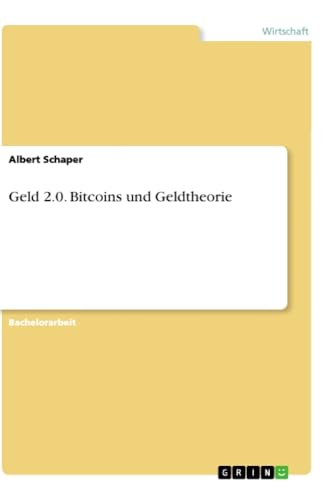
ISBN 978-3-668-08906-8 · Paperback, 68 pages
Expertise, not open access
This page has one purpose: to show why I have taken Bitcoin and Web3 seriously since 2015. The full text is available from the publisher and in bookshops (in German); here I only introduce it.
The thesis provides a monetary-theory perspective from 2015, before US spot bitcoin ETFs and today's agent-payment protocols: What is money? Which properties must it have? And does Bitcoin meet these criteria?
Is Bitcoin money? The central question of the thesis
„Das Ziel dieser Arbeit ist es zu untersuchen, ob der Bitcoin diese Funktionen und Eigenschaften des Geldes besitzt und somit als Geld qualifiziert werden kann.“
Free translation: “The aim of this thesis is to examine whether Bitcoin has these functions and properties of money and can therefore be qualified as money.”
— From the summary, Geld 2.0. Bitcoins und Geldtheorie (2015)
In 2015 this question was controversial. Today it shapes regulatory, tax and business decisions — from the accounting treatment of crypto assets to the question of whether Bitcoin belongs in a treasury strategy.
2015 in context
In the year the thesis was written, Bitcoin averaged around 270 US dollars and Ethereum launched in summer 2015. Central banks were already studying virtual currencies: the ECB published detailed reports in October 2012 and February 2015. The thesis examines Bitcoin as money in that historical setting.
Price series source: Blockchain.com, Market Price (USD). Rounded month-end values are shown.
Bitcoin at the end of 2015 vs. current data
The thesis was written in 2015, when Bitcoin was still a niche topic. The comparison shows the order of magnitude of the change; all current values are a dated 7-day average, not live prices.
| Metric | End of 2015 | Data as of | Change |
|---|---|---|---|
| Bitcoin price (year-end) | ~$430 | ~$84,000 | ≈ ×200 |
| Market capitalization | ~$6.5 billion | ~$1.7 trillion | ≈ ×260 |
| Hash rate | ~0.8 EH/s | ~990 EH/s | ≈ ×1,200 |
| Daily transactions | ~180,000 | ~720,000 | ≈ ×4 |
Data as of 10 October 2026 (7-day average). Source: Blockchain.com Charts. Figures for 2015 and the changes are rounded and show orders of magnitude, not live prices.
Bitcoin in 2015: events in the year of writing
The year the thesis was written was anything but quiet. These events show why the question “Is Bitcoin money?” was already pressing:
What the book delivers
- A monetary-theory test framework: three functions of money (medium of exchange, unit of account, store of value) and six properties (scarcity, portability, value, divisibility, durability, homogeneity), applied systematically to Bitcoin.
- Original survey: an empirical study of how Bitcoin is perceived, from the choice of method and sample to the evaluation.
- Comparison: Bitcoin versus Ripple and Litecoin as well as the euro and the US dollar, along transaction costs, taxation, anonymity and regulation.
- Market variables: how market capitalization, volatility, returns and transaction frequency affect Bitcoin’s quality as money.
Who the book is for
- Founders and entrepreneurs who want to understand Bitcoin as an asset and a payment network
- Students and researchers in economics, monetary theory or finance
- Investors who want to answer the question “Is Bitcoin money?” seriously
- Teams looking for my expertise on Web3, custody or payment projects
Table of contents: structure of the thesis
Seven chapters lead from monetary theory through an original survey to an economic assessment of Bitcoin (chapter titles translated from German):
- Introduction Aims of the thesis, problem statement and conceptual background, methodology.
- Introduction to monetary theory Functions and properties of money, types of money, cryptocurrencies and the evolution of money.
- Bitcoin basics Acquisition, transactions, network and ecosystem, distinction from Ripple and Litecoin, outlook.
- Survey theory Topic, survey method, sample, design and execution of the survey.
- Survey results Findings of the survey and their interpretation.
- Economic analysis of Bitcoin Classification as money via functions and properties, differences from fiat currencies.
- Conclusion Summary, personal conclusion and starting points for further research.
Bitcoin as money — today
The question that sounded theoretical in 2015 has become operationally relevant:
- Spot ETFs in the US: Since 2024, institutional investors have traded Bitcoin like a classic asset — with corresponding accounting and tax questions.
- Treasury strategies: Companies hold Bitcoin on their balance sheets — the choice between risk asset, store of value and means of payment becomes concrete.
- Regulation in the EU: With MiCA, Europe has a single legal framework for crypto assets for the first time.
- Central bank digital currencies (CBDCs): The debate about digital money forces central banks, too, to redefine the properties of money.
This very intersection of monetary theory, corporate strategy and regulation informs my current consulting work. The book is the academic origin of that perspective.
Frequently asked questions about the book
Is the book still relevant today?
Where can I buy the book?
Why is the full text not available online for free?
What is the difference between the book, the insights and the tools?
Can I hire Albert Schaper for a project?
From theory to practice
“What is money?” is not an academic question — it decides whether a company treats Bitcoin as a balance-sheet item, a means of payment or a risk asset.
On this website you will find the tools to try the technical side yourself:
Wallet Generator — Address Validator — Seed Security
And in-depth articles:
Bitcoin & Web3 basics — overview — How a wallet actually works — UTXO vs. account model — Why addresses need checksums
About the author

Latest on this topic: related insights
Recent articles on Bitcoin, crypto and finance from this site — picked automatically by topic.
Cite this book
Publisher details as listed by GRIN Verlag (Munich, 2015). Copy either format directly.
Schaper, A. (2015). Geld 2.0. Bitcoins und Geldtheorie. GRIN Verlag. https://www.grin.com/document/310354@book{schaper2015geld,
author = {Schaper, Albert},
title = {Geld 2.0. Bitcoins und Geldtheorie},
publisher = {GRIN Verlag},
address = {M{\"u}nchen},
year = {2015},
isbn = {978-3-668-08906-8},
language = {german},
url = {https://www.grin.com/document/310354}
}Sources and data
Publication data, the table of contents and the quoted passage come from the GRIN Verlag page. The print-edition details were also checked against the German bookstore listing.
Historical and current network data come from the Blockchain.com time series for price, market capitalization, hash rate and transactions.
Historical context: ECB report of October 2012, ECB report of February 2015, New York BitLicense and the Ethereum Frontier launch.
Where to buy
GRIN Verlag: publisher page with summary, table of contents, preview, and the paperback and PDF editions.
Buchhandlung Schwartz: paperback edition in the German book trade.
Amazon.com: international product page of the German-language paperback edition.
Paperback: ISBN 978-3-668-08906-8 · 68 pages in the print edition · published 1 December 2015
PDF edition: ISBN 978-3-668-08905-1 · the GRIN work page lists 62 content pages
Product data checked on 30 September 2026. Price, shipping and availability are as shown by the respective shop.
Consulting or collaboration?
The book is an academic classification. My current work focuses on bringing this way of thinking into AI and Web3 projects — from custody concepts to agent payment flows.
Request a conversation